The basic plot of Attack on Titan (or Shingeki no Kyojin as it is referred to in the original Japanese) is simple: humanity has been reduced to a small remnant that lives inside walled areas out of fear of gigantic, humanoid, man-eating creatures known as "Titans" and a diverse cast of soldiers strives to defend our species. I will discuss the plot further only as it relates to my analysis and recommend that one go to Wikipedia or just watch the anime for a full understanding of the story. I would also suggest that those who have not seen the anime not read the post, as I will be discussing many of the surprising plot twists in the story.
Watching the anime, I soon realized that many elements of the story strongly correlated with certain historic events of two generations ago. These events are those relating to the Third Reich in the Second World War and in particular to the Eastern Front. In this parallel the humans clearly resemble the Germans and the Titans the Russians, as portrayed in Nazi propaganda. Obviously, though, these parallels will not be exact as the primary purpose of the series was not allegorical. Finally I will attempt to show how these parallels relate to current events.
To start with, let us look at some of the characters in the anime. The main character in the story is Eren Jager (it should be noted there are variable spellings for various characters due to romanization) who due to her mother's death at the hands of the Titans, vows to kill all those of that species. This of course, is quite similar to the genocidal fantasies of Adolf Hitler regarding not just Jews but also Gypsies and Slavs. The parallel is furthered by the fact that Eren is revealed to be a Titan later much as Hitler had (unsubstantiated) rumours of Jewish ancestry. Lastly, the last name Jager is German for "hunter", which both signifies Eren's actions and furthers the use of Germanic themes and names.
Mikasa is one of the few characters without a visibly European appearance and is in fact acknowledged to be the last Asian in existence. However, this only serves to emphasize the point that the majority of the characters on AoT are white. In addition it can't be forgotten that Mikasa is also explicitly stated to be half-Asian and half-white, reflected by her Germanic surname of "Ackerman" (meaning ploughman). While it shouldn't be surprising considering this is a Japanese production, it is rather amusing that the only Asian character happens to ethnically Japanese, Germany's wartime ally in the Axis.
Going through the names of the remaining list of characters, we find that several of them to be also Germanic:
Armin Arlert-First name refers to Arminius, the semi-legendary deliverer of the German people from Roman rule at the Battle of Teutoburg Forest.
Reiner Braun-Not sure how a name can get more Teutonic than this
Jean Kirchstein-First name is French, but surname is Germanic
Krista Lenz-Again, a highly Germanic name
Commander Erwin Smith is an interesting case since while his last name is quite English, his first name is a fairly obvious references to Feldmarschall Erwin Rommel. Driving home this point is that his birthday is the same day the Wehrmacht commander was forced to commit suicide for his alleged involvement in the July 20th plot.
Turning from the characters we move on to the setting...

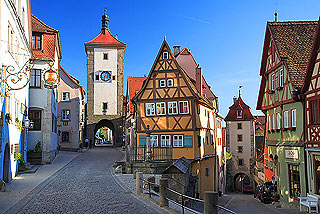
The above is Trost District from AoT, while below is Rothenburg, Germany.
The lyrics of the songs from Attack on Titan further the parallels with the Third Reich. Let us consider the theme song for the first half of the episodes in Season 1, namely "Feurroter Pfeil und Bogen":
Sind Sie das Essen? Nein, wir sind der Jäger!
Unknown are the names of the flowers that have been trampled
Birds have fallen to the earth and long for the wind
Prayers won't solve anything
Only the will to fight can change the here and now!
O pigs who laugh at the resolve
to walk over corpses to move forward
Livestock complacency? False prosperity?
Give us the freedom of dying starving wolves!
The humiliation of being caged is what triggers us to fight back
We hunters slaughter prey beyond the castle walls,
consumed with surging bloodlust,
as our crimson bows and arrows pierce scarlet holes into the twilight
Few songs besides those in patriotic and military songs have such uncompromisingly bellicose lines. In fact one can easily imagine the opening line's rhetorical question of "Are we the prey? No we are the hunters!" on a Nazi-era propaganda poster accompanied perhaps by a Nordic-looking man breaking his chains or in a Feldgrau uniform. The rest of the lyrics are no different: were they slightly reworded in order to be prose, it would not have been out of place in a wartime speech given by Dr. Goebbels urging the German people to commit to a total war effort or in a Das Schwarze Korps editorial attempting to embolden the Wehrmacht, Waffen-SS, Hitler Jugend, and Volkssturm men vainly trying to prevent the advancing Allied troops from entering German soil.
The theme song for the second half of the season, "Flugel der Freiheit" is no different:
O, mein Freund!
Jetzt hier ist ein Sieg.
Dies ist der erste Gloria.
O, mein Freund!
Feiern wir diesen Sieg, für den nächsten Kampf!
"It was a pointless death."
Nobody should say that…
Till we’re down to the last man…
Der Feind ist grausam… Wir bringen…
Der Feind ist riesig… Wir springen…
With gloria in our hands, we sing of sieg, bearing the Flügel der Freiheit upon our backs
(Diese elenden Biester…)
Clenching our resolve to our hearts, we tear through the Ringe der Torheit
(…Werden vernichtet!)
Let us dance in the clear skies——
Flügel der Freiheit!
Der Feind ist grausam…
The opening and certain other segments of "Flugel der Freiheit" have melodies resembling of a marching song. In fact some have found it resembles "La Marseillaise", the French national anthem, although I have not seen any such similarity. Regardless, the song which sings triumphantly of "victory", "glory" and the "next struggle" is one that would have easily fit in with dozens of German military lieder such as the Horst Wessel song, "Vorwats Nach Osten", and many others. But it is with the SS combat song "Sieg Heil Viktoria" that "Flugel der Freiheit bears the most stunning resemblance.
- Ade, mein liebes Schätzelein,
- Ade, ade, ade.
- Es muß, es muß geschieden sein,
- Ade, ade, ade.
- Es geht um Deutschlands Gloria,
- Gloria, Gloria.
- Sieg Heil! Sieg Heil Viktoria!
- Sieg Heil, Viktoria!
I cannot help but wonder if the lyrics for "Flugel der Freiheit" had not been inspired at least partially by this seventy-year old marching song.
Now that we have established the clear presence of Third Reich motifs in Attack on Titan, we must analyze how this relates to the present-day situation. Unlike most other anime that deals with war (such as Gundam or Legend of Galactic Heroes), AoT has not been strongly anti-war in its themes. Indeed, going by the song lyrics shown above, one can even say AoT has militaristic themes. This does not mean, of course that AoT whitewashes war-we see the clear costs of it in the bloody deaths of several characters. Nonetheless, the overall message seems to be that the war against the Titans is necessary for the survival of the human species and its liberation from the confining walls in which the race has been trapped in for so long.
The anti-war animes that I mentioned above were created in the decades following Japan's crushing defeat in the Second World War which included the dubious distinction of being the only country to ever have to suffer atomic bombing on its cities. Due to this national trauma and the enshrinement of pacifism in the postwar Japanese constitution, Japan has maintained a minimally sized military and had a largely antiwar popular culture. Of course there were exceptions, such as the far-right Japanese nationalists (most notably the writer Yukio Mishima who attempted a putsch and committed ritual suicide when it failed), but most Japanese were deeply sceptical of what a large military or foreign wars could cause on the country. However with the passing of the post-World War 2 generation, most Japanese today have no direct memory of the war. In addition China has increasingly exercised itself as a power in the East Asian region, particularly over the Senkaku Islands which are under Japanese control but claimed by Chinese. Due to these factors, Prime Minister Shinzo Abe has urged dropping the provisions which renounce war in the Japanese constitution and expanding the military.
Thus it seems clear that Attack on Titan reflects these evolving attitudes regarding the military in Japanese society. While overall a Japanese military buildup would be a positive for the United States by reducing America's burden of defending its ally, one must be cautious that this does not result in a resurgence of Japanese revanchism or denial of war crimes. In addition, I hope to continue to analyze developments in AoT and see if there are any further parallels with the Third Reich.